Chapter 15 Radio

The first commercial radio station began broadcasting in 1922 in Pittsburgh, Pennsylvania.  Six years later, when I was born, there were many stations.  I don't know when we got our first radio, but we had one as long as I can remember.  That first instrument in my memory was a dark, rectangular wooden box with four or five control knobs on it and a separate round, metallic speaker about 16 inches in diameter.  I don't recall listening to the radio much at that time.  Ruth and I were more into cranking up the phonograph where we could predict what would be played.

            
In 1936, for Christmas, Pa brought home a brand new Zenith radio built into a neat wooden console about four feet tall.  It was fascinating because it had a lighted dial with a round green "eye" at the top of the dial which vacillated in brightness as the sounds were being produced.  The Zenith name had that electrified "Z" which I believe still identifies that company.  Since our home did not yet have electricity, the radio depended on battery power.  We had a wind-blown propeller, called a Windcharger, placed on a high pole in the yard to keep the battery charged.  In periods when the wind was quiet for several days, the battery would run down and the radio would not operate.  A couple of years later when we got electricity in the house, we got a new and even fancier model radio. 

Radio soon became a prominent part of our lives. We listened to the news in the morning and in the evening.  Even then the soap operas, so-called because their advertising sponsors were usually soap companies like Proctor and Gamble promoting the dazzling white washes that their product would guarantee.  After all, you would like to have the wash you have hanging on the line to be whiter and brighter than your neighbor's, wouldn't you?  Among those unending serials were:  Stella Dallas, One Man's Family, As the World Turns, and others. 

           
In terms of sheer volume of listening time, however, baseball was the sport that got the most attention.  We listened to the World Series games, All Star games, and, when not busy hoeing cockleburs, Canadian thistles or weeds in the garden, I would sometimes catch the regular season games too.  Dutch Reagan, later to become President Ronald Reagan, was a sportscaster for the powerful WHO station broadcasting from Des Moines, and would give play-by-play descriptions of the Cub games.  Since I was a Cardinal fan at that time, however, I would usually try to listen to Gene Schumate describe the play of the Redbirds with guys like Ducky Medwick, Pepper Martin, Terry Moore, Marty Marion and those fabulous pitchers, the Dean brothers, Dizzy and Daffy.  I had become a die-hard Cardinal fan because so often their pictures could be found on the back side of the Wheaties boxes in those days.  Incidentally, both Reagan and Schumate broadcast the games by teletype from their studios hundreds of miles from the ball park.  The teletype would give a skeleton description of the game which would come into the studio via typed words.  The sportscaster, then, would add all the color and dramatics from his imagination, sometimes creating drama that had not actually occurred.  Canned crowd noise was added to make the game a bit more realistic, the volume of which was turned up or down as the occasion demanded.  In the last summer I spent at home, 1951, I was able to pick up the real play-by-play of the Cardinal night games from St. Louis as broadcast by a young announcer, Harry Caray, who had the habit of saying "Holy Cow!" every time Stan Musial or Enos Slaughter, or one of the other Redbirds would put one over the fence.
           
There were kid programs too.  Every day after school I would listen to Jack Armstrong, The All-American Boy.  Then, if I got my chores done in time--and I saw to it that I did--I could also listen to Captain Midnight and his exciting adventures as a pilot.  For a couple of box tops of Wheaties and 25 or 50 cents, we could send in for a ring with a little mirror in it.  This would permit you to view, unnoticed, an enemy who might be sneaking up on your rear.  There was a hiko-o-meter which, by placing on your belt, you could measure how far you hiked.  That was great for searching for lost treasure if you had a map with the distances measured on it.

In the evening, the family regularly (weekly) listened to comic programs like Fibber McGee and Molly, Burns and Allen, and the Bob Hope Show. George Burns and Bob Hope, at this writing nearly 60 years later, are still active in the entertainment business.  We also listened to shows of a different type, like the Major Bowes Amateur Hour, and a popular quiz show, Battle of the Sexes, which pitted the intellectual strength of males against females.  But my favorite, never-to-be-missed program, which aired on Wednesday nights, was a show called Gangbusters, depicting real-life accounts of criminals and their activities and how law-enforcement agencies, the good guys, had been able to bring them to justice them.  The story of John Dillinger, the most notorious criminal of the 1930's, was continued for several weeks, describing, finally, his death at the hands of the FBI as he left Chicago's Biograph Theatre on the near north side.  At the end of the program, a "most wanted" bulletin would be issued, usually concluding with the words, "He is armed and considered dangerous.  If you have any information of the whereabouts of this man, please notify your local law enforcement agency or the Federal Bureau of Investigation immediately."  Now, this was the real world, with true-to-life drama.  How much more exciting could it get?

Music on the radio was varied to suit the tastes of many listeners.  Fortunately, it had its share of what we then called Western and Hillbilly music.  WHO in Des Moines broadcast a Barn Dance every Saturday night as did WLS in Chicago.  In my high school years I began to tune into the Grand Ole Opry out of Nashville, and, if the signal was clear enough, would be enthralled with the singing of Eddie Arnold, Ernie Tubb, Roy Acuff and others.  This was the big band era and we also listened to the dance music of Tommy Dorsey, Jimmy Goodman, Lawrence Welk and, especially, the "champaign music" of Guy Lombardo.

Religion, too, had a place on the air waves.  My mother listened every Sunday morning to R.R. Brown from WOI in Omaha, and later, in the 1940's, to Peter Eldersveld of the Christian Reformed Church's Back To God Hour.


We continued to read the daily newspaper, the Des Moines Register, of course, but radio broadened our world considerably.  The newspaper had its comic strips which were regularly enjoyed, but radio brought us comedians and music and drama such as had not been available before.  To the present generation radio may seem rather primitive and dull, but actually, with the aid of sound effects and a vivid imagination, radio drama was, I believe, every bit as exciting as it was after television became the popular media vehicle in the early 1950's.  Music could be enjoyed perhaps even better without the distractions of the visual being added to it.  Today, radio is largely talk shows and music, areas where the imagination need not function intensively.  But when I was young, to borrow the title of a country song, "I saw it all on the radio."


Grab the paperback copy of "Looking Back" HERE!


Read more stories by clicking on the links below:

Chapter 14 The Party Line

The telephone of my childhood years was really quite a marvelous invention.  It was only a bit over 50 years old in my day and most of my kind of people were utterly amazed to think that a voice could travel in(?) over(?) through(?) a wire for so many miles.
            
The telephone of the thirties and early forties was a brown, varnished, rectangular box attached to the wall with the longer dimension in the vertical position.  On the left hand side a black receiver hung on a two-pronged device which acted as an on-off switch:  "Off" when the receiver was hanging; "on" when the receiver was taken off.  On the front were two bells resembling a pair of all-observant eyes, and, just below them, a mouthpiece protruding like a horn.  On the right hand side of the box was a small crank-like handle by which we could "ring" other people or get in contact with "central."  Central was a telephone operator in town who made all the connections at a switchboard.  Central was always--I mean, always--a female.  Clearly, this was a woman's job.
            
Operator in Richardson Texas
For most calls we would first have to get in contact with central.  To do so, we would crank the handle briefly producing one short ring and she would respond with "Number, please".  After telling her the number she would connect our line to the line of the other party and ring the phone of that party.
             
People in the rural areas, and possibly also in the towns, were on party lines, meaning that several homes would be connected to the same phone line on which the signals would be transmitted.  There were at least 12 homes connected to our party line.  Each home had a different ring signal to identify who should answer the phone which would ring in all the homes at the same time.  Our signal was 2 longs, meaning the phone would ring two long rings.  Others would have a short and a long; or a long and a short; or a long, short, long; or two shorts and a long, etc.  Five longs was a signal from central meaning that everyone on the party line should pick up their phones and listen.  Five longs usually consisted of important announcements made by the town, or perhaps by some business in town announcing a sale or some other event that everyone should know about.  If schools were to be closed for a blizzard this would be announced with the five longs followed by the message.
            
If you and the party you wished to call were on the same line you could ring the person directly by cranking the handle the appropriate lengths and times to send that signal over the line.  Now, of course, since all these homes were on the same line, any person could listen in to the calls directed to any other home.  We always knew that a short-long-short was the Ed Johnsons, and two longs and a short was the Thoresons, etc.  And, since the parties talking had no way of knowing who was listening, it was an accepted practice to listen in and get filled in on the latest gossip occurring in the neighborhood.  Now, I say it was an "accepted practice."  That doesn't mean it was totally polite to do so, but the clicks being heard from receivers being lifted to listen in were so common that everyone really expected to have other listeners.  If one wished to pass on something very confidential on the phone, one would have to listen to the number of clicks being heard.  This would indicate how many people were listening.  Then, by commencing to talk at length about trivial matters, the receivers would often go back on their hooks producing similar clicks.  When the clicks from the "hang-ups" equaled the number which were heard at the beginning of the call, one could usually count on privacy.  The certainty of this privacy, how- ever, was never absolute.  It was always possible that two listeners had picked up their receivers at exactly the same time producing what would sound like only one click instead of two.  So, really confidential information was best kept for other than telephone communication.
            
There would be times when the party line would be tied up so long by loquacious persons (usually female) that the only hope of ever getting a call placed was to interrupt the conversation with a polite: "Would you mind letting me have the line for a while?  I have a very important call to make."  Invariably the conversants would hang up.  But, you had better be sure to demonstrate that your call was important for their curiosity would guarantee that they would listen in to see.  There would also be times when the number of listeners on one call would become so excessive that the phone signal would become weak and the caller would have to request that people hang up so the conversation could be understood.
            
On occasions when there was a serious illness in a home or another unusual event, more receivers than usual would be lifted.  I remember one occasion when Duane, the 17 year-old son of Ed and Sylvia Johnson, was seriously ill.  My mother listened in to a call to the Johnsons to find out how Duane was progressing.  It was a call from old Doctor Judd suggesting that they apply a hot water bottle to his hurting abdomen.  Ma had just heard recently that you should apply cold and not hot to an appendix problem, which this apparently--or at least, possibly--was.  That put Ma in a real dilemma:  Should she call Mrs. Johnson and tell her that that was the wrong advice?  Her dilemma was not that this would reveal that she had been listening in.  That could be understood and easily forgiven, especially when it indicated concern for a sick son.  The problem was:  Who was she to dispute their old physician, someone in his seventies, and a fellow member of their Methodist Church?  Now it so happened that my parents, and Ma especially, had no respect for the medical wisdom of old Dr. Judd who had lost touch with the latest in medical science and who had allegedly buried many of his mistakes.  Shouldn't one remain silent rather than dispute the advice of a licensed physician?  But, on the other hand, what if she did apply the hot water bottle and something disastrous happened?
            
If I remember, conscience won out with my mother and she did call Sylvia Johnson shortly thereafter and suggested that the wisdom of applying the hot water bottle was questionable in this situation.  I don't know how Ma's advice was received, or whether it was followed.  I do know Duane died a short time later, a consequence, however, more of his deficient production of white blood cells than of the hot or cold applications to his abdominal regions.  Duane was a classmate of brother Harold.  His death was quite a blow to the Johnson family which knew him as their only child.
           
Modern communication has come a long way since the telephones of the thirties, and much of that distance, to be sure, has been progress.  Privacy, a newly-discovered constitutional right, can now be reasonably assured in telephone conversations.  But with that advance, something has also been seriously wounded: the party line and the accompanying sense of community which it fostered.  And one may question whether the victory for privacy outweighs the loss suffered for community.


Grab the paperback copy of "Looking Back" HERE!

Chapter 13 The Special Times

Life on the farm had its interesting times, but even the most interesting times were not exactly exciting, usually.  But the year was punctuated with those occasional events which provided minor highlights to our lives, the kind of events one looked forward to for days in advance.  And then they would come, be over, and we would wait for them to come again next year.
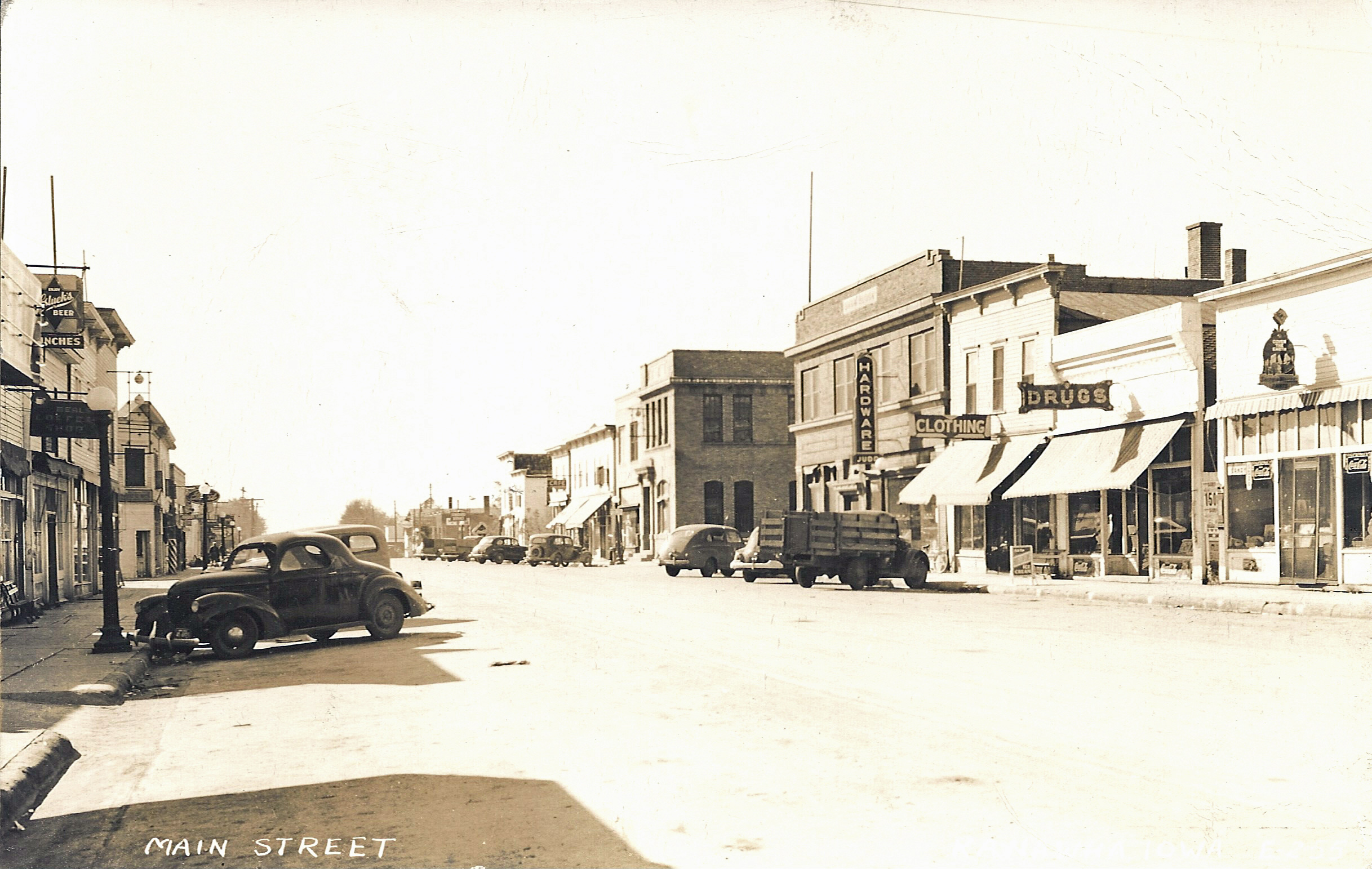
Kanawha Iowa around 1943

Did you ever hear of Maybasketing?  I'm not sure just what Maybasketing is, was, or was supposed to be.  I believe the practice entailed making a pretty little basket, lining it with flowers and decorative material, filling it with candy and other tasty delights and then, affixed with a note, hanging it on the door of someone you took a fancy to--of the opposite gender of course.  After hanging it on the door, one was to call loudly, "May--basket!", then disappear, leaving the recipient to open the door, delight in her discovery, and muse on the romantic gesture which had just graced her life.
           
I say, I think that is the way the art of Maybasketing was meant to be conducted.  But, I really don't know because by time the custom had come down to my generation in that neck of the woods where I grew up, it had been corrupted beyond recognition.  Here is the way we did Maybasketing.
            
Early in the month of May--we did observe the right month--some of us at school would get together during a recess and decide to Maybasket someone that night.  For example, Leonard and Donald Davids and Percy and Bernard Roskamp and I would decide we would Maybasket the Johnsons or the Larsons--families who lived within easy walking distance and who had kids about our age.  We would leave home about dark and meet at the school, and from there we would walk to the place, maybe a half mile distant.  Arriving at the Larsons, we would get as close to the house as we dared and then all shout, "Maaay-bass-ket!  Maay-bass-ket!"  Then run for cover, for that was the signal for the people in the house to come out and catch you, which, if they were any kind of sports at all, they would endeavor to do.  After they had come out, of course, it would be difficult for them to locate you for their eyes were not adjusted to the darkness yet, and besides, you would be concealed behind some tree or shrub or gasoline tank, if possible.  But, it was the duty of the Maybasketers to continue hollering, "Maay-bass-ket," to give them a clue as to where you were.  As they headed in your direction, of course, you tried to switch your position and avoid being caught.  Eventually, they might catch all of you and the game would be over.  Or if you were very elusive and a faster runner able to maneuver around the obstacles in the darkness, they would finally give up and you and anyone else who eluded capture could count themselves as the winners.
            
A stupid game, right?  Especially since we never even dreamed of bringing a real Maybasket.  Only once did we do that.  Wendell Burnham who lived in a shack-like house half way between our place and the school, was from a poor family, and he had been ill for a couple of weeks.  I'm not sure who suggested it, but we went there one May night and actually delivered a basket with some goodies in it.  We didn't play the usual game; instead, we were invited in and Mrs. Burnham thanked us graciously for the treats we had given them. 
            
The thrill of Maybasketing was also partly the venture into the darkness of the night, the excitement of the game of trying to avoid being caught as we stumbled over obstacles in the darkness or ran into barbed wire fences.  On the other side, what drama, when sitting by the kerosene lamp, reading a book, to hear outside the beckoning wail of "Maay-bass-ket,  Maay-bass-ket."  It was the siren to invade the darkness and discover who would so honor you by bringing this adventure into your life this night.
            
And then, too, let's admit it, we sometimes did other things under the veil of darkness as we were on the way to or from Maybasketing.  One night we decided to take the string that we had found from an old softball and run several strands of it across the road while we held on to it from the opposite ditches.  When the first car came roaring down that gravel road we jerked it up just as he approached the spot.  We expected him to barrel right through the string, but to our surprise he slammed on his brakes, careened sideways in a cloud of dust and almost tipped his car.  We instantly fled in terror and only later turned to watch as he started up his car again and drove off into the night.  How would it have changed my life if that car had tipped over, and the driver or a passenger had been severely injured or killed?  Of such things, I guess, are the lessons of life learned.

Early in June there was the annual Mission Feast which our church always observed.  It was a big event, held on a week day, and would be attended by virtually everyone in our own congregation as well as many visitors, mainly from other Christian Reformed congregations in the broader area.  The event would begin at 9:30 in the morning and would feature two speakers, one of which was often a missionary, and the other a minister noted as a gifted speaker from some other part of the country.  The missionaries would give inspsiring sermons or talk about their mission work in Africa or China or among the Navajo Indians, and would sometimes show slides of their work.  On some occasions they would have special meetings with the children, dress up like the natives and show how the witch doctor carried on his evil craft.
            
At noon the ladies of the church would serve a big meal.  In all honesty, this along with a second meal served at about 6 o'clock, was the part of Mission Fest which I probably enjoyed the most, for we kids were allowed to eat together and we stuffed ourselves with all the delectable food.
           
The afternoon would have two more speakers; and then at night, allowing time for the men to go home and milk the cows and feed the pigs, the final session would be held.  Often some kind of music--a quartet, a duet or a trumpeter--would provide some inspirational entertainment and then it was time for the big name outside speaker to deliver the climactic speech, a speech which would convince everyone again of the urgency of going out into all the world to preach the gospel.  And if we were not called to preach the gospel specifically, or be a missionary in some foreign land, at least we could give, and give generously, that the kingdom of Christ would conquer from Greenland's icy mountains to India's coral strand; from Africa's sunny fountains to some other benighted, godless land.  The collection would follow, and it was always a big one.  Regular church service collections in those depressed days saw collection plates contain mainly quarters, dimes, nickels and pennies.  This one was strictly green stuff, filling the plate to the brim.
            
The mission feasts were good experiences for me.  The speakers were usually interesting, even to kids, and they excited in me some of the drama of our place and purpose in the world.  We were not here just to make it through and hope to get to heaven some day; no, we had a mission to accomplish, worlds to win for Christ.  And it was something we all had to do together as the people of God.

A little later in the summer there would be the yearly Sunday School picnic.  In my younger years that was always held at West Lake park.  There were two lakes about 4 or 5 miles east of town known as the twin lakes.  East Lake was the bigger twin, but West Lake had a bigger grove of oak trees with a flat, grassy area where ball games could be played and foot races run. 
           
The picnic would, for some reason, always be on a sunny day.  For us kid it would begin as soon as we arrived on the scene, usually about 11:30 when the mothers had to get the food together and the men had to set up the tables, get the ball diamond in shape, and make other preparations.  Meanwhile, the kids would go down by the lake to look for frogs, throw stones at ducks and get their tennis shoes muddy.
            
After the meal, which was the first highlight, there would be a short program, and then the event for which the whole picnic, it seemed to me, was planned and conducted: the races.  Each sunday school class, which typically had two grade levels, would have a race for the boys.  I'm not sure what the girls did, but they didn't count much anyway.  On the years that I was in the top grade, like a 6th grader in the 5th and 6th grade class, I could invariably expect to win the race, and always did.  I would beat out Donald Cooper, Harry Peters, Leo Abbas, cousin Alvin and a couple others.  The next year, however, I would always have to compete against Carl Cooper who was in the grade ahead of me.  Carl always beat me, forcing me to be adopt a bit more humility.

The Fourth of July was a big day for celebrations.  Long before I knew anything about the Declaration of Independence being signed on that day in Philadelphia in 1776, I knew that the Fourth of July was a very important day.  It must have been, for it was a holiday, the mail was not delivered, nobody worked, and everyone would celebrate the day.  And celebration meant one thing in those days: a carnival-like atmosphere on a town main street or city park where there were ferris wheels, merry-go-rounds, tilt-a-whirls, contests, soft drinks (known to us only as pop), ice cream and crowds of people milling around, moving from one concession to another.  The afternoon might see a baseball game featuring the best athletes from two rival towns pitted against each other.  At night there would often be a fireworks display.
           
The town of Kanawha never had a celebration on the Fourth of July during my childhood, but we could count on some other nearby town to have one.  The first such one that I can distinctly remember was in Garner, about 20 miles northeast of us.  It was a stifling hot day.  I tagged along with my dad up and down main street.  We came to the theatre.  Pa saw the sign that there was air-conditioning inside; so inside we went and there I saw the first movie of my life.  It was a western featuring Ken Maynard.  Ken was handsome, riding his white horse and dressed in a black shirt with a neckerchief and a light-colored cowboy hat.  He bravely rescued a damsel in distress and became my hero for years to come.  I couldn't get over the marvel of the picture show.  My father was a bit embarrassed about my eagerness to discuss this with everyone because movies were really a kind of a no, no in the denomination at the time.  Although my parents were never very rigid about this regulation, and later, as teenagers we often went to "shows," but it was not the kind of thing that we were encouraged to tell the preacher about.
           
In later years, when I finally understood what the Fourth of July meant, most communities had given up the practice of holding Fourth of July celebrations.  One would have to go to a larger city farther away, or to Clear Lake where the Bayside amusement park would have its biggest day of the year.  In my later, high school years we began to hold our Sunday School picnics at Renwick Park on that day along with the Wright Christian Reformed Church.  After the picnic, and after the chores were completed, the young people would then head off for Clear Lake to spend the evening.

The town of Kanawha, as I said, did not celebrate the Fourth; but somewhere between the end of June and early August there would be a town celebration.  I'm not sure what the celebration was for, but there would be the usual things that celebrations had: the rides, the concessions, the hot dogs, the pop and ice cream and the crowds of people coming from all over to celebrate.  I guess they came to celebrate life and good times as people have done for centuries.  The Kanawha town celebration would take place on the two block main street, the heart of the town.
           
One of the events I remember with some clarity was the challenge a man on a platform gave saying he would suffer the hazard of being run over by a tractor if enough people put their money down as an encouragement for him to do it.  After enough money had been collected he did indeed go through with it.  He wrapped himself in a thick blanket, whereupon a rubber-tired John Deere tractor carefully rode one of its wheels over him.  He got up unscathed, quite healthy, and a bit richer than he had been before; and the crowd, I believe, slightly disappointed that it had been performed
so easily.
            
Then there was that ugly brute of a man on the platform before the boxing tent, dressed in boxing shorts with a towel slung around his neck.  The barker challenged anyone in the crowd to take him on in a three round match and win 60 per cent of the gate if he could lick the boxer standing there.  Little did he know that we had Vance Basler in our community; and good-looking Vance had recently won the State Golden Gloves boxing tournament.  Vance stood there quietly and listened to the challenges as the crowd egged him to go in there and beat the crap out of that stranger.  Vance, with an admirable calm and a cool air about him, finally accepted the challenge and went in there to do battle with the hairy-chested monster.  I was not allowed to witness this match, whether because of the outrageous price of a whole dollar being charged for the tickets, or because my dad had principles against the brutality of the sport, I do not know.  In any case, we found out shortly that Vance had made short work of the vicious-looking out-of-towner.  Chalk one up for the home town boy.
           
One of the things we were warned about from the pulpit was the peep shows.  As a lure to gain customers, a girl in a grass skirt, a halter and little else, would wiggle around on the stage in front of the tent right there on main street while a barker invited the crowd to come in and see her dance and take it off.  My dad, with me as a seven or eight-year-old in tow, stopped by briefly--out of curiosity, I suppose--to see if things were really all that bad.
            
         "Come on in gentlemen.  Come on in and see Milly.  Milly can wiggle her belly like a bowl full of jelly."
            
As the barker finally wound down his speech a stupendous thing happened which left my mouth hanging open for minutes.  Milly, right up there on that platform and in full view of all the men and even some boys, began to twist and gyrate vigorously for several seconds.  Then suddenly she turned her backside to the crowd, flung off her grass skirt, shook her derriere, and, just as quickly, ran inside the tent.  I was absolutely flabbergasted.  Though too young to catch the full sexual import of that action, the brazen naughtiness of a person who would expose her fanny to all those people utterly defied my youthful credulity.  I think Pa was a little surprised by it too--or maybe he wasn't--and a bit embarrassed.  I was speechless for some time.  Later, when I recovered, I would tell all my friends I had seen a "nekked" lady.

Less spectacular, but still a highlight of the year was the annual Ladies Aid Sale.  Ladies in the church attended a weekly Ladies Aid society in which there would be a Bible study and an hour or so devoted to sewing, quiltwork, stitchery or some other fancy needlework.  About early September they would devote an evening at the church and Bud Johnson would auction off all the items which had been made.  The proceeds of the sale would go to a mission cause.
            
That was all fine and good, but the exciting part of the Ladies Aid Sale was that the kids were free to do as they pleased during the sale.  We played hide and seek out in the darkness, and tag, and sometimes even explored peoples' back- yards for apple trees and forbidden fruit.  But when the last pillowcase had been auctioned off and the profits were being counted, it was time for the treats.  Ice cream, scooped from a huge container, and cherry pie, and peach pie, and apple pie, and chocolate cake were all available.  And we kids could share in it, even though we had not sewn a stitch or bid on a single doiley.  We were part of the community and so the ice cream and pie and cake were for us too.  And usually they could not get rid of it all, so there were even seconds to be had.  Is there anything better than that?  Food is a part of every worthwhile celebration.

Hunting and fishing were never important in my life.  Every fall Pa would hunt pheasants in our cornfields with his twelve gauge shotgun.  Pheasants were abundant in our area at that time and the few times that I walked along with him I observed him shoot down several colorful birds.  I never tried it.  As a matter of fact, I never fired a shotgun.  I did a little hunting--very little--with a rifle.  One day after a heavy snowfall I tracked a jack rabbit and roused him from his lair.  He ran in his winter white coat for about a hundred feet, then stopped to survey the situation.  I shot and killed him.  The snow absorbed the little pool of blood he spilled.  It was rather sad to see this proud little animal's life snuffed out.  On another occasion I took one shot at a small flock of crows flying overhead.  One black crow fell to the earth, dead.  I was reminded of the time when, as a nine-year-old, I had spent a few days at Uncle Bert Roskamp's place and had felled a robin with a sling shot.  Cousin Theressa, ten years my senior, found the lifeless creature and questioned me whether I had done that sad deed.  I'm not sure whether I confessed or denied it, but after her little sermon on respecting animal life, I just never felt enthusiastic about killing animals.
            
We went fishing two or three times a summer, especially on days when the fields were too wet to work.  Usually we fished the lakes within 20 miles of our place and generally caught only bullheads which, while very good to eat, were not especially exciting to catch.  On one occasion we traveled to Lost Island Lake about 80 miles from us where we even staid in a cabin overnight.  We caught well over a hundred fish.  I liked some aspects of fishing.  Getting out on the water was rather enjoyable; but baiting the hooks, waiting for bites, unhooking the fish, untangling the reels, were all rather distasteful experiences for me which failed to compensate for the meager pleasure I derived from the sport.  Some have suggested that if I had done some real fishing, fishing of game fish, I would have become an enthusiast.  But I doubt it.  Most of the fishing enthusiasts that I knew were even enthusiastic about bullhead fishing.  I wasn't.  Too bad, perhaps; but that's the way it is.

Christmas back then, was not greatly unlike now.  It had colored lights, though fewer of them; presents, though fewer of them; and school programs and Sunday School programs.  In these programs we children all had our opportunities to "speak our piece" (or was it peace?).  I was usually commended for speaking mine loud and clear, but, I never enjoyed memorization, and on at least one occasion I got stuck and needed assistance to continue.  After the Sunday school program, which was always held on Christmas Eve, the presents to the teachers and from the teachers would be distributed, and a sack with a variety of candies and nuts, along with an apple and orange, would be given to each Sunday school pupil.  That brown sack of goodies was more anticipated than the present from the teacher, and it became something of a challenge between Ruth and me to see who would be able to exercise the greater self-control and extend the enjoyment of its contents over a longer period.  I learned early that consuming those goodies too soon would result in agony as I would have to endure watching her continue to enjoy hers.  Now, Ruth was a reasonably generous sister, but there was a certain principle of justice here that ruled out any sharing in this case.  
            
Our family exchanged gifts in our home after the Sunday School program.  I don't recall that cousins were ever involved in this exchange.  Since we kids rarely had opportunities to earn money, and allowances were unheard of, most of the giving was by our parents.  I remember little about the gifts I received.  One year I got a cowboy suit and hat which I was quite excited about since at that stage in life's adventure, I was quite sure that I would grow up to be a cowboy.  I had requested a bee-bee gun for a number of years and finally got one when I was a sophomore in high school.  By that time, I felt I had outgrown it and was even ashamed to let my friends know that I had gotten it.
            
We usually had a Christmas tree, but it took on much more significance after 1938 when we got electricity and could enjoy the colorful lights.  Town people, of course, had the benefit of electricity and colored lights long before we did. Candles were used more frequently back then, and were sometimes even placed on the Christmas tree. They were seldom lit, though, because this was clearly understood to be hazardous. 
           
I remember virtually nothing of New Year's Days until about my high school years when the Big Ten began playing against the Pacific Coast schools in the Rose Bowl.  Since there wasn't television, football bowl games did not have the prominence that they do now, although Rosebowl games have been played since about 1900.  On New Year's Eve, however, Ma would always make "Spekkin Dikken", or Old Year's cakes, a tradition handed down from the old country (Germany).  These were made of pancakes covering some kind of sweet sausage, liberally soaked in hot fat.  Not bad, except I liked plain pancakes bathed in luscious corn syrup better.

Today, of course, society is much more sophisticated.  We have the benefits of the technological explosion, giving us computers, television, videos, and other electronic games.  And these things give us a lot of vicarious thrills, thrills available at the flick of a switch whenever we want them.  And we have a calendar full of various organized sports which keep us occupied year round.  But it seems we have fewer of those community events which drew us together back then, fewer of those notable interruptions to the routine which added zest to the lives of my generation when I was growing up.  Maybe it's all in the perspective of one's age.  Maybe today's youth will also look back from a similar vantage point and recount the highlights that sprinkled their years with spice.  But I sort of doubt it.


Grab the paperback copy of "Looking Back" HERE!


Read more stories by clicking on the links below:


Chapter 12: Kittenball

We called it "kittenball" in those days.  For what reason I never thought to ask and still have not discovered.

But it was softball, the twelve inch variety with the fast, underhand pitch.  We played a lot of that in country school.  Baseball, the nine inch variety played by major leagu­ers, would come later in high school, and to a limited degree, in post-high school and college.  Kitten­ball was ideal for children, not only because it wasn't as hard as the baseball, but because it didn't require as large a playing field.  The one-acre school grounds which were typical of Iowa rural schools in my day were just large enough to contain a softball play­ing field and small enough so that 7th and 8th graders could sometimes hit one over the fence for a homerun.  Al­though I believe that in our rules, since the fence was a mere single cable strung through evenly spaced wooden posts, we never regarded hitting one over it as an automatic homer­un.  The batter would have to earn everything he got, and the fielder would duck under the cable and try desperately to retrieve the ball from the ditch and throw it home before the runner could circle the bases.           

Nevertheless, hitting it over the fence was something of a feat that didn't occur frequently.  


I remember when sister Ruth was in 8th grade she could really clobber the ball and, to the amazement of espec­ially us underclassmen, she would occasion­ally even clout one, not only over the fence, but onto the road beyond the ditch.
           
My first experience with softball was as a first-grader.  For some reason the big kids decided to let us little ones play one day.  I remember batting and finally hitting the ball, whereupon I ran to the pitcher instead of first base.  The older kids, I thought, made much more of that little blunder than it de­served. "Hey, not to the pitch­er!  Over here, Dummy--to first base!  Dontcha know any better?" That ended my softball experience for a while.  But by third grade softball before school, during reces­ses and noon lunch hour was a regular part of my grade school experience.
           
Since the whole school typically had only twelve to sixteen students, most kids above the second grade were in­cluded in the games.  Usually two older players would choose sides by one tossing the bat to the other and then each would alternate going hand over hand up the handle of the bat.  The last one able to get his hand on the bat handle with enough grip to toss it backward over his head would get the first pick.  From there the choices from the first to the last would be virtually predeter­mined.
            
Somewhere in these years, probably about fourth or fifth grade, someone introduced a new variation in our game.  Instead of the traditional diamond shaped infield, a triangular infield was devised consisting only  of 1st base, 2nd base and home plate.  This proved to be a real boon to our game because it required fewer players: A pitcher, catcher, 1st baseman, 2nd baseman and two out­field­ers.
            
One of the highlights of our rural school softball experience would be the inter-school com-petition.  My school, Norway Township District # 3, had occasional rivalries with the "East School" (Dist. # 2), the "North School" (Amsterdam Township # 9), the "West School" (Boone Township # 1) and the "Siemens School" (Boone Township # 6).  Our most frequent competition and greatest rivalry, however, was with the "South School" (Norway Town­ship #4) where the Veldhouse boys attended.  These could be fiercely contested games and closely matched.


In sixth grade a new development occurred: Allstar teams from the different townships would compete against each other for the County championship. 


I remember the tryout for that first township team.  Being only a 6th grader, I didn't regard my chances of making the team to be very good, but I would give it a shot.  As I recall, two teams were formed to play against each other, and from that game the manager would de­termine the selection.
     
It was not a good day.  I was supposed to have gotten a pair of tennis shoes by that time (already into the month of May), but for some reason, I didn't have them yet.  No doubt, I blamed my mother for that inexcusable negligence.  Anyway, I played the game in my ankle-high, slippery, leather-soled work shoes.  I was distressed that I did not play well: my quickness, my running, my fielding were hampered by those slippery shoes on the grass infield.  Then, when the game ended, I stupidly went with Bernard (a non-contender) into the school building, unaware that the manager was going to pick the team right after the game.  When I went back out some 10 or 15 minutes later, all the players were seated around him while he was making the last selec­tions for the team.  In addition to the older players like Danny Veldhouse, a whirlwind pitcher and eighth grader, he had also chosen his brother, my friend Jay, from the South School.  Bob Larson, a class­mate from my own school was also chosen, as were a couple other sixth graders.  Now, Bob was no better than I was, and in my opinion, not as good.  But he made it.  And Jay made it.  And a couple other sixth graders were selected for the reserves.  Desper­ately I tried to make myself very conspicu­ous as the manager made the final selections.  He looked my way, but made no nod.  He didn't even ask my name.  I was passed over!  Not chosen!  Why?  Did he think me slow and clumsy (be­cause of my shoes)?  Did he simply over­look me (because I had not been there when he had started picking)?
            
Whatever the reasons for my being omitted, I was devastated.  Especially now that Jay and Bob and other sixth graders had made the squad, things were put in an entirely different light.  My pride suffered.  Had they not made it either, I would have had no problem.  But they did make it and I did not.  How could I explain that to others?


I went home that night swamped in gloom and embarrassment.  


Then I did something very cowardly which would multiply my misery for two or three weeks to come.  Pa asked me how I did, whether I made the team.  Fumbling for an acceptable answer, I said I made it--"as a substitute."  It was a lie.  No other way to describe it.  Even though I may have held some wispy, remote hope that a couple players would break their legs and that they might need someone else, and I would surely be next in line, I knew without question that I had not been selected in any capacity.  But how could I bear the humiliation of inform­ing my dad that I wasn't good enough, when Jay and Bob and other sixth graders did get chosen?  Besides, Pa would be disappointed too, as I had attempted--frequently, no doubt--to impress him with the notion that I was among the best of players at my tender age.
            
The days came when the team went to play in the inter-township competition, and then on to Clarion where they won the County championship behind the pitch­ing of Danny Veldhouse.  But I know nothing of those games. I wasn't there.  No playe­rs had broken their legs and I wasn't needed or even thought of.  I could, I suppose, have attended the games.  My parents would probably have taken me if the field work was not too pressing.  But no way did I want my parents to know about these games.  Better they should forget the whole thing and spare me the humiliation of exposing my rejection for the team on which I supposedly had been selected as a substitute.  They didn't bring up anything about the team or the games we were to play.  I was relieved to believe it had passed from their minds.  But, a boy's sins have a way of finding one out.  My biggest embarrassment was yet to come.
           
It was the day of the Norway Township end-of-year school picnic in mid-May at which time the eighth graders from the various schools in the town­ship would have their combined graduation ceremony.  It was a warm, sunny day as it always seemed to be when picnics were held.  Renwick park, with the Boone River flowing lazily through it, was dressed in its spring greenery and the hickory trees shaded the outdoor platform where the ten or twelve eighth graders were as­sembled waiting for that moment when they would receive their diplomas. In addition to the gradu­ation itself, the program would in­clude various honors being distributed, a couple of vocal numbers and a short speech by the County Superintendent of Schools, Claude W. Sankey.  Many, if not most, par­ents of the school children in the township would attend this yearly picnic along with their childre­n.  My parents would certainly be there because Ruth was graduating that year.
           
The program began before an audience of 50 to 75 people seated in folding chairs before the stand.  I was sitting in the back row, or possibly standing there behind it.  Superinten­dent Sankey conducted the prel­im­in­aries, a couple of numbers were performed, and then it hap­pened!  Mr. Sankey announced:  "I would like at this time to honor the team from Norway Township which recently won the County Softball Championship."  My heart sank; my face began to flush.  I had hoped my folks, my dad in particular, would have forgotten all about that team that I presumably had been a member of.
            
Sankey went on: "And now, I would like to call the team members up to receive their blue ribbons." Oh no!  It would all come out.  Paul Assink would get no ribbons; his name would not even be men­tioned.  I quietly slipped away from the audience and hurried over to the refreshment stand where I could cover my humiliation amid the people buying ice cream cones and pop, people oblivious to the trauma I was experiencing within.            


How I spent the rest of the day I do not recall. I only remember weakly explaining to my dad that I had been a "back-up substitute", whatever that lie was supposed to mean.  


Pride.  It goeth before the fall.  Or maybe it is the fall.  What an evil monster it is in human life.  Why didn't I just come right out at the start and admit:  "I didn't make it.  I feel real bad."?  But I didn't.  The disappointment would have passed shortly and I could have proceeded to cope with the situa­tion in honesty.  As it was, my suffering was protracted over weeks and compounded with addition­al humili­ation.  And my character was weakened by my failure to accept reality.
    
Looking back on that episode, I can now say that I have learned from it.  But I didn't at the time.  Sadly, that weak­ness would be repeated in my later experiences where, instead of con­fronting situations head on, I would learn to escape pain by avoiding the very situations that might cause the pain.  I'm not proud of that flawed aspect of my development.  But time passes.  Disappointments and embarrassments recede into the background and, while never obliterated and leaving their scars, one is allowed to function again without obvious and crippling impairment.
           
The next year I was in 7th grade.  I don't recall how I was selected, but I made the allstar team this time, apparently without a sweat, and played third base.  I distinctly remember the first game of the tournament: Norway Township against Boone Township.  The Boone team had three of my second cousins on it--Bill, Kenny and Paul Siemens--and a whirlwind pitcher named Mary Knudson--a girl, can you believe it?  We never had girls on our team, regardless of how good they may have been. But, be that as it may, I remember the conclusi­on of the game vividly because we were behind much of the game but were rallying in the last inning.  With two outs, I was on third, Bob Larson was on second and Jay Veldhouse was at bat.  The count went to one ball and two strikes.  Superin­tendent Sankey was umpiring the game.  Knudson got set for her next pitch, whipped it toward the plate.  Jay swung.  From that point on everyth­ing erupted into chaos.  Jay foul-tipped the ball; the catcher dropped it.  We were still alive!  But no.  Mr. Sankey called, "Strike three!"            


The game was over?  We were instantly stunned.  But wait.  


If that was strike three and first base is not occupied, the batter could run to first when the catcher dropped the ball.  Finally, someone said, "Run to first!"  The Boone catcher, mean-whil­e, had already regained control of the ball and now, reassessing the situation, decided that he should tag the batter, which he did.
            "Out" Sankey called, thrusting his thumb upward.  It took a couple of seconds to comprehe­nd the situa­tion.  By then some of the Boone team began their wild celebration of victory, while our team descended on Sankey en masse simil­ar to a modern baseball bench-clear­ing brawl.
            "That was a foul tip!  The batter is not out!  Didn't ya see that?"  We argued des­perately.  We argued vehemently. "If the batter had missed the third strike, why wouldn't he have run immediately?  The catcher didn't tag him at first because he knew it was a foul tip too.  Dontcha see?  That was a foul tip!  --a foul tip, foul tip."
            Sankey stood his ground. Boone was now jubila­nt in victory while gradually the tumult of our futile protests subsided.  Within ten minutes the diamond was clearing and the bitter finality of the decision was setting in.  I remember making one last protest to Mr. Sankey as he was walking away:  "That really was a foul tip."
            Sankey smiled, put his arm on my shoulder and said something to the effect of "Now, now.  It's hard, but you'll get over it."            


He was right, of course, but unlike most incidents in my life, this one has stuck in my memory for over a half century; so maybe he was wrong.  


I often wondered whether Mr. Sankey really didn't know that it was a foul tip.  Did he purposely, knowingly, falsify the call?  I find it hard to believe that he did.  I suspect, but will never know--and it makes little difference--that he called strike three by mis­take, realized that he was wrong but not soon enough to reverse himself with dignity.           


In any case, it was only a game.  But seventh graders are not very philosophical about things as important as winning and losing, especially when winning would allow you to advance to the final round and play for the championship of the county.  


Never mind, of course, that even if he had called it a foul tip, Jay might have struck out on the next pitch, or popped harmlessly to the short­stop, and the game would have had the same result.  But the fact was, in our minds, we could have won and gone on to greater glory had we not been robbed by that call.

Next year, as an eighth grader in the spring of '42, we had another such tournament.  Strangely, I remember little about it.  I remember being the pitcher that year and I remember that we defeated the Boone team easily this time.  I also remember that among the cheering fans for the Norway team there was a tall, good-looking, dark-haired eighth grade girl whose name I discovered was Frances Thompson.  She attended the District # 7 school located in the southeast corner of the township nearer to Clarion.  Frances seemed to be very excited about the game and--interestingly--particularly about my pitching.  I would remember that and the fact that we did make some trivial exchange of conversation after the game.  Beyond that, however, nothing came of it, not for the time being at least.
            
After defeating Boone, the Norway team was supposed to play in Clarion for the County championship.  I draw a blank about that event.  Apparently it never happened; surely I would remember it.  I suspect the day was probably rained out and, because school would end somewhere around the 10th to the 15th of May and the township eighth grade graduation program would be held within a week of that, the event was most likely cancelled.  So, once again, deprived of the opportunity for the supreme glory of a championship, I would ring down my grade school education and the kiten­ball that was so much a part of it.

Read more...

Chapter 11: On the Farm - Fieldwork
Chapter 10: On the Farm - Chores
Chapter 9: On the Farm - Playtimes
Chapter 8: One Room Schoolhouse - Norway Township #3
Chapter 7: 1934
Chapter 6: Amsterdam Township #4
Chapter 5: Birthplace - North Central Iowa 


Or grab the paperback copy of the book HERE!